Kumar Shahani
Kumar Shahani is an Indian director, best known for Tamil cinema. Kumar Shahani began their career in 1984. With 30 credits to their name, Kumar Shahani remains one of the most prolific and celebrated talents in the industry. Kumar Shahani is one of the most closely watched talents of their generation, with a rapidly growing body of acclaimed work.
Career Milestones
Film debut
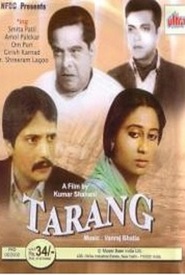
View film →Highest rated: Tarang (7.7)
View film →Defining Moments
Debut Feature Film
Release of his first feature film 'Maya Darpan', establishing his formalist style in Indian parallel cinema.
Release of 'Tarang'
Completion and release of his epic film 'Tarang', a critical examination of industrial capitalism in India.
Padma Shri Award
Awarded the Padma Shri by the Government of India for his contributions to Indian cinema.
Kumar Shahani by the Numbers
If you watched every Kumar Shahani film back-to-back, you'd be at it for roughly 7 hours. Most-paired with M. K. Raina — 2 films together.
Filmography
See all 30 credits →
Collaboration Network
Career Analytics
Language Distribution
Films by Decade
Top Co-Actors
See all →Kumar Shahani has worked most frequently with M. K. Raina (2 films).

Did You Know?
Kumar Shahani is a pioneering Indian film director known for his work in parallel cinema.
He studied at the Film and Television Institute of India (FTII) in Pune.
Shahani was a student of the renowned Indian filmmaker Ritwik Ghatak.
His debut feature film was 'Maya Darpan' (1972), which is considered a landmark in Indian art cinema.
He is known for his highly stylized and formalist approach to filmmaking.
Legacy & Influence
Kumar Shahani is a seminal figure in Indian parallel cinema, renowned for his rigorous formalist and avant-garde approach. Emerging from the Film and Television Institute of India (FTII), where he was a student of Ritwik Ghatak, and further influenced by Robert Bresson during a stint in France, Shahani forged a distinct cinematic language that broke from mainstream narrative conventions. His debut feature, 'Maya Darpan' (1972), funded by the NFDC, is a landmark of Indian structuralist filmmaking, employing long takes, a minimalist aesthetic, and a focus on the interior lives of characters within rigid social structures to critique post-colonial India. His subsequent works, most notably the epic 'Tarang' (1984), expanded his exploration of class, capital, and historical memory through a meticulously composed tableau-like style, often described as 'epic materialism.' Shahani's filmography, though limited, includes other significant works like 'Khayal Gatha' (1989), which examines the classical music tradition, and 'Char Adhyay' (1997), an adaptation of Tagore. His contribution lies not in commercial success but in expanding the philosophical and aesthetic possibilities of the Indian film form. He insisted on cinema as a means of knowledge and critical inquiry, influencing generations of independent filmmakers and scholars. As a teacher and theorist, his writings and lectures have profoundly shaped discourse on Indian cinematic modernism, cementing his legacy as a pioneering intellectual force who challenged audiences to engage with film as a serious, contemplative art.