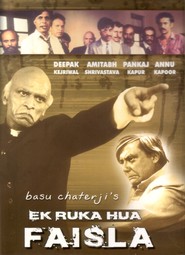
Ek Ruka Hua Faisla Full Story Explained (1986)
Imagine being the only person who believes a teenage boy might be innocent. Everyone else has already decided he is guilty. That is the heart of 'Ek Ruka Hua Faisla'. This 1986 Hindi legal drama is directed by Basu Chatterjee. It is a brilliant remake of the classic film '12 Angry Men'. The entire movie takes place inside a single jury room. Twelve ordinary men argue about the fate of a young boy from a slum. He is accused of killing his own father. If found guilty, he will be hanged. The film is tense, smart, and deeply emotional. It makes you question your own biases. You will watch these twelve men fight, shout, and change. It is a masterclass in acting and storytelling. Every single performance is top-notch. This is not just a movie about a trial. It is a movie about human nature.
One Boy's Life Hangs
A teenage boy from a city slum is on trial. He is accused of stabbing his father to death. The judge tells the jury their decision must be unanimous. If they say guilty, the boy gets the death sentence. The case seems open and shut. Everyone expects a quick verdict.
Full Plot
The film begins in a crowded courtroom. A teenage boy from a slum is on trial for murdering his father. The judge gives his final instructions to the jury. He tells them their verdict must be unanimous. If they find the boy guilty, he will be sentenced to death. The twelve jurors then file into a small, hot room to decide his fate.
Inside the room, the men are eager to leave quickly. They take an initial vote. To their surprise, one man votes 'not guilty'. That man is Juror 8, played by K. K. Raina. He is a calm and thoughtful architect. He does not claim the boy is innocent. He simply says the case deserves a proper discussion before they send a boy to die. The other jurors are annoyed. They argue that the evidence is clear. Two witnesses saw the boy do it. The murder weapon was a rare knife that the boy owned. Why waste time?
Juror 8 does not back down. He begins to question the evidence piece by piece. First, he looks at the old man who lived downstairs. This man claimed he heard the boy shout 'I will kill you' and then saw him run down the stairs. Juror 8 proves the old man could not have reached his door in time because he was slow and limped. Next, he examines the woman across the street. She claimed she saw the stabbing through the windows of a passing train. Juror 8 shows that the train was moving too fast for a clear view. He also points out that the knife, supposedly rare, is actually a common model that anyone could buy.
As Juror 8 presents each point, the other jurors begin to doubt. One by one, they change their votes. Juror 9, an elderly man played by Annu Kapoor, is the first to switch. He respects Juror 8's logic. Juror 5, who grew up in a slum, also changes his mind. He understands the boy's life. Juror 11, a refugee, speaks about the value of justice. The room becomes a battlefield of emotions. Juror 3, played by Pankaj Kapur, fights the hardest. He is a bitter man with a broken relationship with his own son. His anger is personal, not logical.
The vote shifts slowly. It goes from 11-1 to 10-2, then to 8-4, and finally to 6-6. The room is divided. Juror 3 screams and shouts. He pulls out a photo of his son and tears it. He is not arguing about the case anymore. He is fighting his own demons. In the end, Juror 8 forces him to see the truth. Juror 3 breaks down. He sobs and changes his vote to 'not guilty'. The verdict is unanimous. The boy is free. The twelve men leave the room in silence, forever changed by the experience.
Act Breakdown
The Guilty Verdict
The film opens in the courtroom. The judge gives his final instructions. The twelve jurors enter the discussion room. They take a quick vote. Eleven vote guilty. Only Juror 8 votes not guilty. The others are angry and impatient. They want to leave quickly.
Doubt Takes Root
Juror 8 presents his first arguments. He questions the old man's testimony. He proves the old man could not have reached the door. The vote changes to 10-2. The room becomes more tense. Juror 3 starts shouting. The group is splitting.
The Battle of Wills
The arguments get deeper. Juror 8 questions the woman's testimony. He proves the train made it impossible to see clearly. He also shows the knife is not unique. The vote keeps shifting. It reaches 6-6. Juror 3's personal pain is revealed.
The Final Breakdown
Juror 3 is the last holdout. He screams about his own son. He tears up his son's photo. Juror 8 calmly asks him to think. Juror 3 finally breaks down. He votes not guilty. The verdict is unanimous. The men leave in silence.
Characters
Juror 8
Played by K. K. Raina
Juror 8 is the calm heart of the film. He is an architect who believes in fairness. He is the only one who initially votes 'not guilty'. He does not know if the boy is innocent, but he insists on a proper discussion. He patiently dismantles every piece of evidence. His quiet logic wins over the other eleven men.
Juror 3
Played by Pankaj Kapur
Juror 3 is the loudest and most aggressive juror. He has a deep personal grudge against young people. His own son ran away from home years ago. He projects his anger onto the accused boy. He fights the verdict until the very end. He finally breaks down and votes 'not guilty' when he confronts his own pain.
Juror 9
Played by Annu Kapoor
Juror 9 is a wise and elderly man. He is the first juror to change his vote after Juror 8. He respects careful reasoning. He sees the prejudice in the room and speaks against it. He is quiet but observant. He represents the voice of conscience in the group.
Juror 4
Played by S. M. Zaheer
Juror 4 is a stockbroker who trusts only facts. He is calm and logical. He initially believes the boy is guilty based on the evidence. He is the hardest to convince because he relies on what he sees. He only changes his vote when Juror 8 proves the eyewitness could not have seen the murder.
Juror 10
Played by Subbiraj Kakkar
Juror 10 is a prejudiced man. He openly hates people from slums. He believes the boy is guilty simply because of where he comes from. He makes bigoted statements during the discussion. The other jurors turn their backs on him in shame. He represents the danger of blind prejudice.
Juror 1
Played by Deepak Qazir Kejriwal
Juror 1 is the foreman of the jury. He is a nervous and indecisive man. He tries to keep order in the room but often fails. He is not a strong leader. He just wants the process to end smoothly. He eventually votes 'not guilty' along with the majority.
Scene Highlights
The First Vote
The jurors are settling into the room. They are hot and irritated. The foreman calls for a vote. He asks them to raise their hands for guilty. Eleven hands go up. Juror 8 keeps his hand down. The room goes silent. Everyone stares at him. He calmly says the boy deserves a discussion.
The Knife Demonstration
Juror 8 pulls out an identical knife from his pocket. The court said the murder weapon was a rare switchblade. Juror 8 bought the exact same knife from a shop down the street. The other jurors are shocked. This proves the knife was not unique. The case against the boy weakens significantly.
The Old Man's Walk
Juror 8 recreates the old man's walk. The old man claimed he reached the door in 15 seconds. Juror 8 walks the same distance in the room. He proves it takes much longer, especially for a man with a limp. The other jurors realize the old man was lying or mistaken.
Juror 3's Breakdown
Juror 3 is screaming at everyone. He pulls out a photo of his son. He shouts that his son is worthless. He tears the photo in half. Then he breaks down crying. He finally admits he is angry at his own son, not the accused boy. The room falls silent with pity.
The Final Walk Out
The verdict is read. The boy is not guilty. The twelve men stand up slowly. They do not look at each other. They file out of the room one by one. The camera stays on the empty room. The fan still spins. The chairs are messy. Justice has been done.
Cast & Context
The casting of 'Ek Ruka Hua Faisla' is a masterstroke. The film brings together some of the finest stage and screen actors of India. Pankaj Kapur, known for his intense roles, delivers a powerhouse performance as Juror 3. K. K. Raina and M. K. Raina, who are real-life brothers, play opposing jurors. Annu Kapoor, a veteran character actor, brings warmth to Juror 9. The entire cast is filled with National School of Drama graduates. This shared training gives the film a raw, theatrical energy. Audiences loved seeing these brilliant actors in a single room, fighting with words alone.
Themes
Reasonable Doubt
The entire film rests on this idea. Juror 8 does not need to prove the boy is innocent. He only needs to show that the evidence is not perfect. He proves that the witnesses could be wrong. He shows that the knife is not unique. Doubt is enough to save a life.
Prejudice vs Justice
Several jurors bring their personal biases into the room. Juror 3 hates his own son. Juror 10 hates poor people. Juror 7 just wants to leave for a cricket match. These prejudices almost cost an innocent boy his life. The film shows how dangerous bias can be in a court of law.
The Power of One Voice
One man standing alone can change the world. Juror 8 is outnumbered eleven to one. He does not shout or fight. He simply speaks the truth calmly. His patience and logic slowly convince everyone else. The film shows that courage is not about being loud. It is about being right.
Personal Pain and Anger
Juror 3's anger is not about the case. It is about his own broken family. He has not seen his son in three years. He takes out his pain on the accused boy. The film shows that we often project our own hurt onto others. True justice requires us to let go of that pain.
Music & Soundtrack
The film has no songs. It is a pure dialogue-driven drama. The background score is minimal and subtle. The sound of the fan, the ticking clock, and the rain outside create the atmosphere. The silence between arguments is more powerful than any music.
Similar Films
This is the original American film that 'Ek Ruka Hua Faisla' is a direct remake of. Both films share the exact same plot and structure.
Both are courtroom dramas where a single person fights against a system. Both films focus on intense dialogue and moral dilemmas.
This Hindi film also deals with a flawed legal system. It shows how a small-town lawyer fights for justice against powerful people.
Both films are courtroom dramas that challenge societal prejudices. 'Pink' focuses on the bias against women, while 'Ek Ruka Hua Faisla' focuses on class bias.
Ending Explained
The final scene of the film is deeply emotional. The vote has reached a tie at 6-6. Only Juror 3 is holding out. He is screaming and crying. He pulls out a photo of his son from his wallet. He tears it in anger. Juror 8 calmly asks him to look at the evidence without rage. He asks him to imagine being in the boy's place. Juror 3 finally breaks down. He sobs uncontrollably. He throws his vote onto the table and shouts 'Not guilty'. The verdict is now unanimous. The boy is free. The twelve men sit in stunned silence. They slowly gather their things and leave the room. They do not celebrate. They do not shake hands. They walk out as different people. The camera shows the empty jury room. The fan still spins. The chairs are messy. The film ends with a quiet sense of justice served. The message is clear: justice is hard work, but it is worth fighting for.
This film is an absolute must-watch. If you love smart, dialogue-driven dramas, you will adore it. The acting is flawless. Every single actor delivers a career-best performance. The story is tight and never boring. The film makes you think about your own biases. It is a masterclass in patience and logic. The only weakness is the dated production quality. The film looks and feels like a TV movie from the 80s. But that does not matter. The content is timeless. Watch it for Pankaj Kapur's explosive performance. Watch it for the brilliant writing. You will not regret it.
Frequently Asked Questions
Yes, it is a direct remake of the 1957 American film '12 Angry Men' directed by Sidney Lumet. That film itself was based on a 1954 teleplay by Reginald Rose. The Hindi version stays very close to the original story.
The film is directed by Basu Chatterjee. He was a famous Indian director known for making simple, middle-class stories. His other famous films include 'Chhoti Si Baat' and 'Rajnigandha'.
The entire film takes place inside a single jury room. It was likely shot on a studio set. There are no outdoor locations in the movie. The setting is claustrophobic and hot, which adds to the tension.
The title translates to 'A Pending Decision' in English. It refers to the verdict that is stuck or pending. The jury cannot decide quickly. The decision is 'stuck' because of one man's doubt. The title captures the central conflict of the film.
No, India does not have a jury system like the one shown in the film. Jury trials were abolished in India in 1960 after the famous Nanavati case. The film uses the jury as a dramatic device to explore human nature.