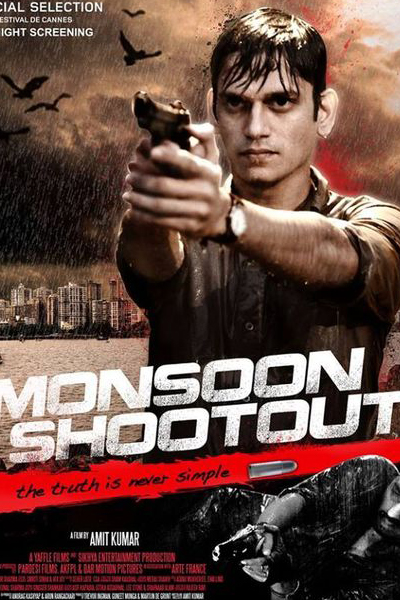
Monsoon Shootout Full Story Explained (2017)
Imagine you are a rookie cop in Mumbai. It is raining non-stop. You chase a killer into a dark alley. You have your gun pointed at him. You have one second to decide: shoot or don't shoot. This is the moment that defines Monsoon Shootout. The film stars Vijay Varma as Adi, a principled young officer. Nawazuddin Siddiqui plays Shiva, the dangerous criminal he chases. The movie released in 2017 after a long journey. It first premiered at the Cannes Film Festival in 2013. Director Amit Kumar made a film that asks a simple question: what happens when you make the wrong choice? The answer is not simple at all. The film shows three different versions of the same moment. Each version leads to a completely different story. It is a dark, stylish, and emotional ride through Mumbai's rainy streets.
The Alley Decision
Adi is a rookie cop on his first night. He chases a man named Shiva into a dead-end alley. Shiva is a feared gangster. Adi has his gun raised. He has one second to decide. Shoot or don't shoot. This one choice changes everything.
Full Plot
Monsoon Shootout is a Hindi neo-noir thriller set in Mumbai during the heavy monsoon season. The story follows Aditya, or Adi, a rookie police officer who joins an elite anti-extortion unit led by Inspector Khan. Khan is a tough, no-nonsense cop who believes in using force to fight crime. On his very first evening on the job, Adi plans to meet his ex-girlfriend Anu to win her back. But he misses their date because Khan sets up an ambush for a dangerous gangster named Shiva.
The ambush goes wrong. Shiva escapes into the crowded streets. Adi chases him alone into a dark, narrow alley. He corners Shiva and points his gun at him. But Adi hesitates. He is not sure if Shiva is really the wanted criminal. This moment of hesitation is the film's central idea. The story then splits into three different versions. Each version shows what happens based on Adi's choice: to shoot, not to shoot, or to hesitate.
In the first version, Adi shoots Shiva. He kills him. But he soon discovers that Shiva was not the gangster. He was an innocent man. Adi is consumed by guilt. He tries to hide the truth, but it destroys him. His relationship with Anu ends. He becomes a broken, haunted man. Inspector Khan covers up the mistake, but Adi cannot forgive himself.
In the second version, Adi does not shoot. He lets Shiva go. Shiva turns out to be a ruthless killer. He goes on to murder more people, including a police officer. Adi feels responsible for every death that follows. He tries to track Shiva down, but he is always one step behind. The guilt eats him alive. He realizes that letting a criminal go can be just as dangerous as killing an innocent man.
In the third version, Adi hesitates. He does not shoot, but he does not let Shiva go either. This version explores the middle ground. Adi tries to arrest Shiva, but things get complicated. Shiva's wife Rani gets involved. Adi learns that Shiva is not just a monster. He is also a father and a husband. The line between good and bad blurs. Adi struggles to do the right thing in a world where nothing is black and white.
Each version ends with a different outcome. But all of them share one thing: loss. Adi loses his innocence, his love, or his life. The film does not tell you which choice is right. It shows you the cost of every decision. The monsoon rain is a constant presence, washing the streets but never cleaning the guilt. The film ends with the same question it started with: what would you do in that alley?
Act Breakdown
The Setup
We meet Adi, a rookie cop with strong morals. He joins Inspector Khan's unit. He plans to meet his ex-girlfriend Anu. But Khan sets up an ambush for Shiva. The ambush fails. Adi chases Shiva into an alley. He has to make a split-second decision.
The Choice
The film reaches its central moment. Adi has his gun on Shiva. The rain pours down. He has one second to decide. The screen freezes. The story splits into three paths. The interval leaves the audience wondering what will happen next.
The Consequences
Each version of the story unfolds. In one, Adi kills an innocent man. In another, he lets a killer go free. In the third, he tries to arrest Shiva. Each path leads to more violence, guilt, and loss. Adi's relationships suffer. His morals are tested.
The Final Reckoning
Each version reaches its end. Adi faces the consequences of his choice. He loses his love, his innocence, or his life. The rain continues to fall. The film ends without a clear winner. The message is that every choice has a cost. There is no happy ending.
Characters
Aditya 'Adi'
Played by Vijay Varma
Adi is a young, principled police officer. He wants to be an honest cop in a corrupt system. On his first night, he chases a suspected gangster into an alley. His decision in that moment changes his life forever. In every version of the story, he faces guilt, loss, or death.
Shiva
Played by Nawazuddin Siddiqui
Shiva is a feared criminal in Mumbai's underworld. He is ruthless and violent. But he is also a father and a husband. His character changes depending on Adi's choice. In some versions, he is a cold-blooded killer. In others, he is a desperate man trying to protect his family.
Inspector Khan
Played by Neeraj Kabi
Khan is the leader of the anti-extortion unit. He is a tough, no-nonsense cop. He believes in using violence to fight crime. He tells Adi to shoot first and ask questions later. He represents the corrupt system that Adi is trying to resist.
Anu
Played by Geetanjali Thapa
Anu is Adi's ex-girlfriend. She is a kind and caring woman. Adi wants to win her back. But his job and his choices push her away. In every version of the story, their relationship suffers because of the violence in his life.
Rani
Played by Tannishtha Chatterjee
Rani is Shiva's wife. She is a strong woman who loves her husband and son. She gets caught in the middle of the conflict. She tries to protect her family from the violence. Her role shows the human cost of the gangster life.
Scene Highlights
The Alley Confrontation
This is the film's central scene. Adi chases Shiva into a narrow, dark alley. The rain is pouring. Adi has his gun pointed at Shiva. He is breathing hard. He has one second to decide. The camera holds on his face. The moment is tense and powerful. This scene repeats in all three versions.
The Gas Leak Confrontation
In one version, Adi does not shoot. He later tracks Shiva to a building. There is a gas leak. The building could explode. Adi and Shiva face each other again. The tension is unbearable. The scene shows how one choice leads to another dangerous situation.
Adi's Guilt
In the version where Adi shoots an innocent man, he is consumed by guilt. He sits alone in his room. He cannot sleep. He sees the man's face everywhere. His relationship with Anu falls apart. The scene is quiet but emotionally devastating. It shows the real cost of a wrong decision.
Rani's Plea
Rani, Shiva's wife, confronts Adi. She begs him to leave her husband alone. She says Shiva is a good father. She does not want her son to lose his father. The scene humanizes Shiva. It makes Adi question his mission. It shows that even criminals have families who love them.
The Final Rain
The film ends with Adi standing in the rain. He is alone. He has lost everything. The camera pulls back. The city is dark and wet. The rain washes the streets but not his guilt. The scene is beautiful and sad. It leaves the audience with a feeling of emptiness.
Cast & Context
Monsoon Shootout marked Vijay Varma's debut in a lead role. He had previously appeared in small roles. The film gave him a chance to showcase his talent. Nawazuddin Siddiqui was already known for his powerful performances in films like 'The Lunchbox' and 'Gangs of Wasseypur'. His presence added weight to the film. The pairing of a newcomer like Varma with an established actor like Siddiqui created a dynamic contrast. The film also featured Neeraj Kabi, known for his intense roles, and Geetanjali Thapa, a rising star. The cast was a mix of fresh faces and experienced actors.
Themes
The Weight of Choice
The film is built around one decision. Adi has to choose whether to shoot or not. Each choice leads to a different story. The film shows that every decision has consequences. There is no perfect choice. Every path leads to pain and loss.
Moral Ambiguity
The film does not have clear heroes or villains. Adi wants to be good, but his choices cause harm. Shiva is a killer, but he is also a father. Inspector Khan is corrupt, but he gets results. The film shows that the world is not black and white. Everyone has a reason for what they do.
The Cost of Violence
Violence is a constant presence in the film. But it is never glorified. Every act of violence has a price. Adi's guilt, Shiva's death, Rani's pain. The film shows that violence destroys everyone it touches. There is no victory, only survival.
The Corrupt System
The police system in the film is broken. Inspector Khan believes in shooting first. The politicians are in bed with gangsters. Adi wants to be honest, but the system forces him to compromise. The film shows that one good person cannot fix a corrupt system alone.
Music & Soundtrack
ComposerMultiple composers (Rochak Kohli, Viveick Rajagopalan, Mayur Narvekar, Chinmay Harshe, Vikram-Chetan); background score by Gingger Shankar
The song 'Pal' sung by Arijit Singh became a hit. It is a romantic track that plays during Adi's memories of Anu. The background score by Gingger Shankar is pulsating and adds tension to the chase scenes. The music matches the film's dark, rainy mood.
Similar Films
Both films are set in the Indian underworld and feature Nawazuddin Siddiqui in a powerful role. They share a gritty, realistic tone.
Both are dark, neo-noir thrillers set in Mumbai. They explore moral ambiguity and the consequences of violence.
Both films use the 'forking paths' narrative structure. They show how a single decision can lead to completely different outcomes.
Both films feature a cat-and-mouse chase between a cop and a killer. They share a dark, psychological tone.
Ending Explained
The film does not have a single ending. It has three endings, one for each version of Adi's choice. In the first ending, Adi shoots an innocent man. He is haunted by guilt. His relationship with Anu ends. He becomes a broken shell of a man. In the second ending, Adi lets Shiva go. Shiva kills more people. Adi feels responsible. He tries to stop Shiva but fails. He is consumed by guilt. In the third ending, Adi hesitates. He tries to do the right thing, but the situation spirals out of control. People die. Adi is left alone in the rain, questioning everything. The film ends with the same image it started with: Adi in the alley, gun raised, rain falling. The message is clear: there is no right answer. Every choice has a cost. The film leaves the audience with the question: what would you do?
Monsoon Shootout is a film for people who like to think. It is not a fast-paced action movie. It is a slow, moody exploration of choice and guilt. The performances are excellent, especially Vijay Varma and Nawazuddin Siddiqui. The cinematography captures Mumbai's rainy beauty. But the film can feel repetitive because it shows the same moment three times. Some viewers may find it slow. If you like thoughtful, noir thrillers, this is worth watching. If you want a typical Bollywood action film, look elsewhere.
Frequently Asked Questions
No, Monsoon Shootout is not based on a true story. It is an original screenplay written by director Amit Kumar. He was inspired by a short film called 'An Occurrence at Owl Creek Bridge'. That film explores how a single decision can change everything.
The film was shot in 2011. It premiered at Cannes in 2013. But it took four more years to release in theaters. The delay was due to financial and distribution issues. The producers struggled to find a release date. It finally came out on December 15, 2017.
The three versions show the consequences of different choices. In one, Adi shoots. In another, he does not. In the third, he hesitates. Each version explores a different moral path. The film shows that no choice is perfect. Every decision has a price.
The film's soundtrack was created by multiple composers. Rochak Kohli, Viveick Rajagopalan, Mayur Narvekar, Chinmay Harshe, and Vikram-Chetan all contributed songs. The background score was composed by Gingger Shankar. The song 'Pal' sung by Arijit Singh became popular.
Yes, if you like dark, thoughtful thrillers. The film has strong performances, especially from Vijay Varma and Nawazuddin Siddiqui. The cinematography captures Mumbai's rainy streets beautifully. But the film is slow and experimental. It is not a typical action movie. It is more about ideas than action.