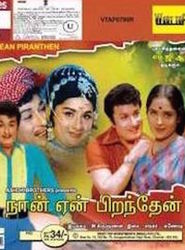
Naan Yen Pirandhen(1972)
Naan Yen Pirandhen is a 1972 Indian Tamil-language drama film directed by M. Krishnan. The film stars M. G. Ramachandran, K. R. Vijaya, and Kanchana in lead roles. It follows Kannan, a married man who hides his marital status to secure a job under a wealthy businessman. When the businessman's paralysed daughter falls in love with him, Kannan must navigate a web of lies without hurting anyone. The film is a remake of the 1953 Telugu film Bratuku Teruvu. It was the only film where Ramachandran played a family-oriented character. The dialogues were written by Vietnam Veedu Sundaram. Despite its strong cast, the film failed commercially and ran for only 10 weeks in theatres.
Quick Facts
- Streaming on
- Sun NXT, YouTube
- Theatrical Release
- 9 June 1972
- Director
- K. Shankar
- Language
- Tamil 0
Storyline
A married man named Kannan lies to his rich boss about being single to keep his job. When the boss's fragile daughter falls in love with him, Kannan must find a way to reveal the truth without breaking her heart or losing his livelihood.
“One lie. One family. One man's sacrifice.”
Film Details
Parental Guide
Where to Watch
Vibe & Tags
Cast & Crew



Reunion Meter
Frequent partnerships reunited for Naan Yen Pirandhen
Cast reunions in this film: K. R. Vijaya & Sankar Ganesh (18 films together), K. R. Vijaya & K. Shankar (11 films together), K. Shankar & M. G. Ramachandran (8 films together), K. R. Vijaya & M. G. Ramachandran (5 films together), M. G. Ramachandran & M. Krishnan Nair (3 films together), and Sankar Ganesh & K. Shankar (2 films together).
Trivia
- This was the first Tamil film to feature the popular actor Sivakumar in a lead role.
- The movie's title translates to 'Why Was I Born?' reflecting the main character's struggles.
- It was directed by K. Shankar, who was better known for his work in Hindi cinema.
- The film's music was composed by M.S. Viswanathan, a leading composer of the era.
- A key plot point involves the village setting, a common backdrop for social dramas of the 1970s.
- The story explores the theme of deception for financial gain, a recurring subject in films of that period.