Kamal Swaroop
Kamal Swaroop is an Indian director, best known for Tamil cinema. Kamal Swaroop began their career in 1988. With 30 credits to their name, Kamal Swaroop remains one of the most prolific and celebrated talents in the industry. Spanning 30+ years, Kamal Swaroop's career remains one of the longest and most celebrated in Tamil cinema.
Biography
Kamal Swaroop is an Indian film director, writer, and screenwriter working in Hindi cinema, best known for the surrealist postmodernist film Om-Dar-Ba-Dar (1988), produced by the National Film Development Corporation of India. His documentary Rangbhoomi (2013), a retelling of Dadasaheb Phalke's life in Benaras, won the National Film Award for Best Non-Feature Film (Golden Lotus), his second National Award. A graduate of the Film and Television Institute of India (FTII, 1974), he assisted Richard Attenborough on Gandhi (1982) and is recognized for an avant-garde, experimental style rooted in Indian mythology and folklore. Om-Dar-Ba-Dar, completed in 1988 but released in Indian theaters only in 2014, is now considered a cult classic of Indian parallel cinema.
Career Milestones
Graduated from FTII Pune and began career as assistant director
Assisted Richard Attenborough on international production
Directorial debut with avant-garde feature, premiered at Berlin International Film Festival
View film →Won Filmfare Critics Award for Best Film
View film →Won National Film Award (Rajat Kamal) for Best Non-Feature Film
Defining Moments
The surrealist opening sequence of Om-Dar-Ba-Dar — cacophonous trumpets, British Raj archival footage, and the protagonist Om's narration about caste reorganization — immediately establishes the film's radical break from conventional Indian cinema.
Set the tone for India's first major avant-garde feature; confounded audiences at the Berlin International Film Festival and signaled a wholly new cinematic language in Indian film.
View film →The 'Tadpole Se Hum' musical sequence — a surrealist nursery-rhyme-as-philosophy-lesson about evolution, identity, and India's directionless metamorphosis.
Frequently cited as the film's most emblematic scene, capturing its postmodern absurdism and its subversive critique of Bollywood's musical conventions.
View film →The surrealist montage of Jagdish being caught with a lock of hair — a sequence that weaponizes editing and form to deconstruct both narrative logic and social taboo.
Widely discussed in Indian cinema criticism as a defining example of avant-garde montage, demonstrating Swaroop's FTII-trained formalism applied to anarchic content.
View film →'Meri Jaan' performance sequence — a delirious fusion of love song, political slogan, and street performance that deconstructs Bollywood sentiment while becoming hypnotic on its own terms.
Considered the emotional and thematic heart of the film; Rajat Dholakia's score turning chaos into choreography made this a touchstone for Indian experimental cinema.
View film →Rangbhoomi — Swaroop's National Award-winning documentary that won the Swarna Kamal (Golden Lotus) at the 61st National Film Awards, cementing his reputation beyond Om-Dar-Ba-Dar.
Confirmed Swaroop as one of India's foremost non-mainstream filmmakers; the President's Award recognition brought his avant-garde sensibility to a wider institutional acknowledgment.
Kamal Swaroop by the Numbers
If you watched every Kamal Swaroop film back-to-back, you'd be at it for roughly 4 hours. Most-paired with Manish Gupta — 2 films together.
Filmography
See all 30 credits →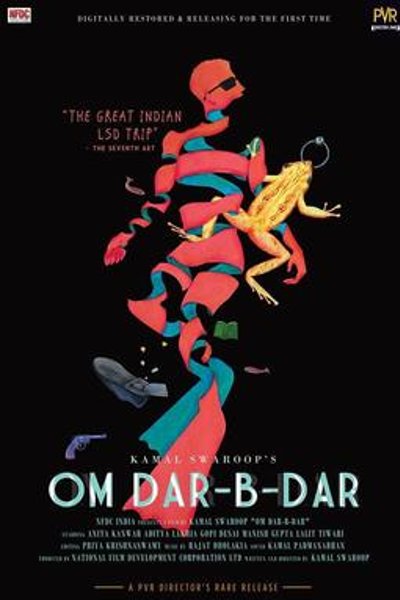
Collaboration Network
The Constellation
Top 3 most-paired collaborators. Bubble size and line thickness reflect how many films they share with Kamal Swaroop.
Career Analytics
Language Distribution
Films by Decade
Top Co-Actors
See all →Kamal Swaroop has worked most frequently with Manish Gupta (2 films), Anita Kanwar (2 films), and Gopi Desai (2 films).

Legacy & Influence
Kamal Swaroop is a pivotal yet unconventional figure in Indian parallel cinema, renowned for his avant-garde and experimental approach to filmmaking. A graduate of the Film and Television Institute of India (FTII), Swaroop first gained significant recognition as a key collaborator with the legendary director Kumar Shahani, working as an assistant on films like 'Tarang' (1984). His own directorial career is defined by a radical, non-linear style that challenges traditional narrative structures and explores myth, history, and memory. His most celebrated work, the 1988 cult classic 'Om-Dar-B-Dar', is a surreal, satirical masterpiece that deconstructs middle-class Indian life. Initially met with confusion and limited release, the film developed a massive underground following over decades and is now hailed as a landmark of Indian independent cinema for its bold formal experimentation and anarchic spirit. Swaroop's filmography, though sparse, includes significant documentaries like 'Rangbhoomi' (2013), an innovative exploration of Dadasaheb Phalke's travelogue that blends documentary with fiction. His contribution lies not in mainstream commercial success but in expanding the language of Indian cinema. He has inspired generations of independent filmmakers and film students with his fearless commitment to personal vision and his scholarly, research-intensive methodology. As a teacher and mentor, his influence extends through his academic engagements, shaping critical thought around film form and history. His work is studied for its philosophical depth and its unique fusion of Indian folk traditions with modernist cinematic techniques.