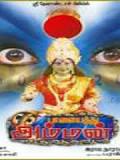
Palayathu Amman(2000)
Palayathu Amman is a 2000 Indian Tamil-language devotional film directed by Rama Narayanan. The film stars Meena as the goddess Palayathu Amman, with Ramki, Divya Unni, Charan Raj, and Vivek in supporting roles. The story follows a saint who prophesies the birth of a goddess in human form to destroy a demon. The demon kills the saint but the goddess is born as a baby girl. She is adopted by a couple, and the demon repeatedly tries to kill her. The goddess protects the child throughout. The film features music composed by S. A. Rajkumar and songs sung by K. S. Chithra and Sujatha Mohan. A comedy subplot involving Vivek's parody of Parasakthi gained notable popularity. The film received mixed reviews but was appreciated for its visual effects in the climax.
Palayathu Amman is streaming on Sun NXT and Airtel Xstream Play.
Where to watch:Quick Facts
- Streaming on
- Sun NXT, Airtel Xstream Play
- Theatrical Release
- 28 October 2000
- Director
- Rama Narayanan
- Language
- Tamil
- Runtime
- 2h 6m
- Rating
- 2.9/10
Storyline
A saint predicts that a goddess will be born as a human child to destroy an evil demon. The demon kills the saint, but the goddess is born as a baby girl. She is adopted by a loving couple. The demon tries to kill the child many times. The goddess Palayathu Amman protects the baby from every attack.
“The goddess protects her own.”
Film Details
Parental Guide
Where to Watch
Vibe & Tags
Cast & Crew






Reunion Meter
Frequent partnerships reunited for Palayathu Amman
Cast reunions in this film: Ramki & Senthil (13 films together), Senthil & Meena (10 films together), Vivek & Ramki (9 films together), Vivek & S. A. Rajkumar (9 films together), Rama Narayanan & S. A. Rajkumar (9 films together), and Meena & S. A. Rajkumar (9 films together).
Trivia
- The film was shot in just 30 days, a common practice for director Rama Narayanan who was known for his fast-paced production schedules.
- Actress Roja, who played the goddess, was a popular lead actress at the time and rarely appeared in purely devotional roles.
- The movie's release coincided with the peak of the 'telefilm' style in Tamil cinema, known for its direct storytelling and devotional themes.
- It was one of several Amman goddess films released around the year 2000, capitalizing on a specific wave of religious fervor in Tamil Nadu.
- The special effects for the goddess's manifestations were done using basic optical techniques, typical for low-budget films of that era.
- The film's soundtrack was composed by Srikanth Deva, marking one of his earlier works before he became a prominent composer.