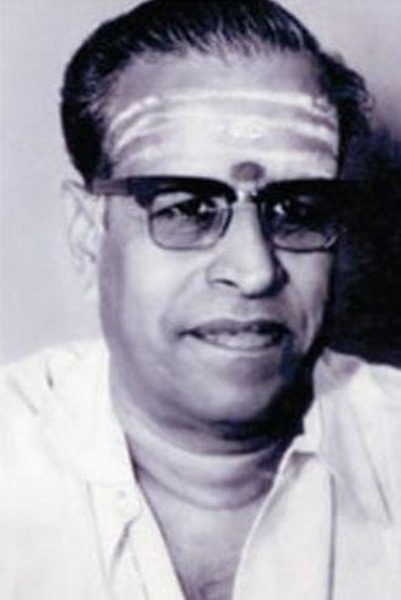
K. V. Mahadevan
K. V. Mahadevan is an Indian composer, best known for Tamil cinema. K. V. Mahadevan began their career in 1960 and has been a prominent figure in the industry for over 66 years. With over 210 credits to their name and an average audience rating of 7.6, K. V. Mahadevan remains one of the most prolific and celebrated talents in the industry. K. V. Mahadevan's influence on Tamil cinema is generational — their work continues to define the standard for the industry.
- Born
- Age
- 108
Biography
Krishnankoil Venkadachalam Mahadevan, known as K. V. Mahadevan, was a prolific music composer who worked across Tamil, Telugu, Malayalam, and Kannada cinema over five decades, composing music for approximately 600 films and over 3,000 songs. He won the inaugural National Film Award for Best Music Direction in 1967 for the Tamil film Kandan Karunai, and received the Filmfare Award South for Best Music Director (Telugu) for Swathi Kiranam (1992). His compositions were deeply rooted in Carnatic classical music, yet rendered accessible to mass audiences through his emphasis on rhythmic intensity and lyrical sensitivity. His celebrated work on Thiruvilaiyadal (1965) and his continued relevance into the early 1990s with films like Alludugaru (1990) and Swathi Kiranam (1992) cemented his legacy as one of South Indian cinema's most enduring composers before his death on June 21, 2001.
Career Milestones
Film debut as music composer
Won inaugural National Film Award for Best Music Direction
Won National Film Award for Best Music Direction (second time)
Composed music for landmark classical film
Won Filmfare Award for Best Music Director (Telugu) for final Telugu film
View film →Defining Moments
Score for Thiruvilaiyadal featuring devotional and classical compositions for the legendary Sivaji Ganesan-starrer about Lord Shiva, blending folk and classical Tamil musical traditions
One of the most celebrated Tamil devotional films ever made; K. V. Mahadevan's music was integral to its mythological grandeur and commercial success. It became a benchmark for devotional film scores in Tamil cinema.
Soundtrack for Kandan Karunai, a mythological film whose music won the inaugural National Film Award for Best Music Direction
Winning the very first National Film Award for Best Music Direction established K. V. Mahadevan as the foremost film composer of his era across South India, recognising his ability to elevate devotional and classical material for popular cinema.
Music score for Sankarabharanam, particularly the devotional composition 'Om Namah Shivaya' using raga Madhyamavati, which became the emotional and spiritual centerpiece of the film
Won the National Film Award for Best Music Direction. The score is widely regarded as one of the greatest achievements in South Indian film music, bringing Carnatic classical traditions to mainstream audiences and cementing K. V. Mahadevan's status as 'Swara Brahma' in Telugu cinema.
Music score for Sirivennela, including lyrical classical compositions that complemented K. Viswanath's story of a blind musician — a collaboration that deepened his reputation for merging classical music with cinematic emotion
Part of his celebrated run of classical-music-themed films with K. Viswanath; the soundtrack is frequently cited as one of the finest in Telugu cinema of the 1980s and helped define a golden era for classical-rooted film music.
Complete musical score blending classical Carnatic music with emotional drama in this story of a Carnatic musician's relationship with a blind girl — the soundtrack became a cult classic
Won the Filmfare Best Music Director Award (Telugu). The film accumulated a cult following specifically for its music and lyrics, and is considered the crowning achievement of his collaboration with director K. Viswanath. Represents his final major landmark work.
View film →K. V. Mahadevan by the Numbers
If you watched every K. V. Mahadevan film back-to-back, you'd be at it for roughly 17 days and 16h. Most-paired with Nagesh — 9 films together.
Filmography
See all 210 credits →
Collaboration Network
The Constellation
Top 10 most-paired collaborators. Bubble size and line thickness reflect how many films they share with K. V. Mahadevan.
Career Analytics
Language Distribution
Films by Decade
Top Co-Actors
See all →K. V. Mahadevan has worked most frequently with K. S. Gopalakrishnan (5 films), V. B. Rajendra Prasad (3 films), R. Sundarrajan (2 films), P. Madhavan (2 films), and D. Yoganand (2 films).



Did You Know?
K. V. Mahadevan was affectionately called 'Mama' by the film industry.
He was a prolific composer in Tamil, Telugu, Kannada, and Malayalam films.
He received the National Film Award for Best Music Direction for the Telugu film 'Sankarabharanam' (1980).
He was honored with the Padma Shri by the Government of India in 1989.
He was a disciple of the Carnatic musician Papanasam Sivan.
Legacy & Influence
K. V. Mahadevan, affectionately known as 'Mama', was a pioneering and prolific music composer in South Indian cinema, leaving an indelible mark primarily in Telugu and Tamil films. His career, spanning over four decades from the 1950s to the 1990s, is distinguished by its versatility, melodic richness, and deep-rooted classical foundation. Mahadevan's early training in Carnatic music under masters like Papanasam Sivan profoundly shaped his compositional style, allowing him to seamlessly blend classical intricacies with popular appeal. This unique synthesis became his signature, making complex ragas accessible to mass audiences and elevating the musical standard of film scores. His legacy is most prominently anchored in his work for the landmark Telugu film 'Sankarabharanam' (1980). The film's music, entirely based on classical Carnatic compositions, was a monumental cultural phenomenon. It not only revived widespread interest in classical music but also demonstrated that pure traditional music could achieve massive commercial success, breaking conventional film music norms. The soundtrack, featuring legendary vocalists like S. P. Balasubrahmanyam and Vani Jayaram, remains a timeless classic, studied and revered for its authenticity and emotional depth. Beyond this magnum opus, Mahadevan composed for over 250 films, contributing memorable scores to other significant works like 'Sri Venkateswara Mahatyam' and 'Sirivennela'. His ability to compose for diverse genres—from mythological and social dramas to folk-based narratives—showcased his exceptional range. He had long-standing, fruitful collaborations with major directors such as K. Viswanath and actors like N.T. Rama Rao. Mahadevan's influence extends to mentoring and inspiring generations of musicians and composers who followed. His work established a benchmark for integrating Indian classical traditions into cinematic storytelling, proving that film music could be both artistically profound and widely popular. His compositions continue to be celebrated for their melodic purity, technical sophistication, and their role in preserving and propagating Indian classical music through the powerful medium of cinema.