Sivaji Ganesan & K. Shankar Movies Together List — 7 Films
Complete Movies List & Collaboration History
Last updated: 2026-07-15 · Data sources: Wikipedia, TMDB
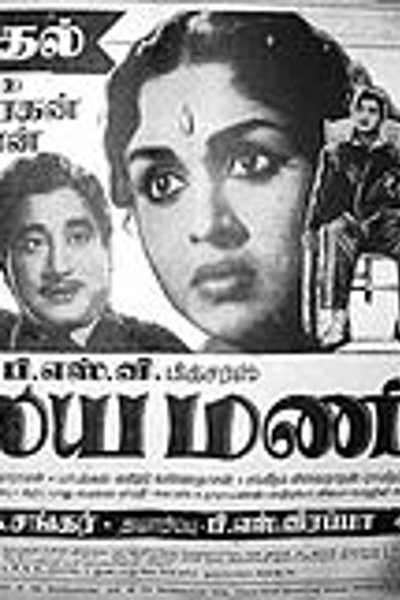
Sivaji Ganesan and K. Shankar appeared together in 7 Tamil films between 1962 and 1985. Their highest-rated collaboration was Aalayamani (1962 — 7.5/10). Films span Aalayamani (1962) through Raja Rishi (1985).
The Sivaji Ganesan & K. Shankar partnership
After 13 years apart, they came back together for Chiranjeevi (1978). They didn't share a set between 1965 and 1978. Their work runs across 3 decades of Tamil cinema.
From Aalayamani (1962) to Raja Rishi (1985). Aalayamani is the one most viewers reach for.
The shape of the work
The 1960s belonged to Aalayamani; the 1980s to Siranjeevi. Sivaji Ganesan acted in every film; K. Shankar directed all of them. Strictly Tamil cinema — they never crossed industries together.
Partnership facts
- Shankar was an editor before he turned director. He spotted Ganesan's raw energy in a stage play and literally walked up to him after the show to pitch Aalayamani (1962). Ganesan said yes on the spot — no script, just trust.
- On the sets of Andavan Kattalai (1964), Ganesan would rewrite his own dialogues in the morning. Shankar never stopped him. Instead, he'd adjust the camera blocking to match Ganesan's new lines — a silent rhythm where the actor led and the director followed.
- Their 1978 film Chiranjeevi launched a young composer named Ilaiyaraaja into the big league. The soundtrack became a sensation, and Shankar later said that Ganesan insisted on giving the newcomer full creative freedom — a move that changed Tamil film music forever.
- After every film wrap, Ganesan would personally drive Shankar home in his own car — no driver, no entourage. They'd stop for a single cup of filter coffee at a roadside stall near Kodambakkam. This ritual lasted through all seven films, even after both became superstars.
- Ganesan once told a magazine: 'Shankar doesn't direct me. He just opens a door and lets me walk through. That's why I keep coming back.' The quote appeared in a 1985 interview for the release of Raja Rishi.
- In Ezhudhadha Sattangal (1984), Ganesan played a double role. Shankar shot both characters in the same frame using a split-screen technique — a first for both of them. Ganesan had to time his movements to the second, and Shankar stood beside the camera counting beats aloud like a conductor.
7 films across 3 decades
The 1960s brought 3 films together, anchored by Aalayamani (7.5/10).
The 1970s accounted for 1 film.
The 1980s accounted for 3 films, averaging 6.5/10.
- Aalayamani
- Andavan Kattalai0
- Chiranjeevi0
- Siranjeevi
- Raja Rishi
The partnership in numbers
Partnership Pattern
7 films across 23 years represents consistent collaboration.
Language Distribution
Linguistic diversity: 1 language, with Tamil being their primary medium.
Where each was in their career
37% of K. Shankar's screen credits are with Sivaji Ganesan. After Raja Rishi, Sivaji Ganesan kept going for 28 more films; K. Shankar stepped back.
Before Aalayamani, Sivaji Ganesan had starred in 17 films, including Pasamalar (1961) and Palum Pazhamum (1961).
After Raja Rishi, Sivaji Ganesan went on to appear in 28 more films, including Mudhal Kural (1992) and Mannukkul Vairam (1986).
Before Aalayamani, K. Shankar had directed 2 films, including Kairasi (1960) and Kavalai Illaadha Manithan (1960).
After Raja Rishi, K. Shankar went on to direct 10 more films, including Meenakshi Thiruvilaiyadal (1989) and Aayiram Kannudayaal (1986).
Collaboration Journey
A chronological view of Sivaji Ganesan & K. Shankar's professional partnership
Actors and musicians who worked on most of their films
People who worked on Sivaji Ganesan & K. Shankar's films together
 2
2 2
2 2
2 2
2






 2
2 22
22Other iconic Tamil director-actor duos
Discover other partnerships with comparable filmographies and ratings